Physics demonstrations
Make equilibrium, torque, energy and motor control visible through supervised bench tests.
Class XII Physics Investigatory Project
What does it take to keep a mini drone in the air? Explore how thrust, power, payload and balance shape the flight of a quadcopter.
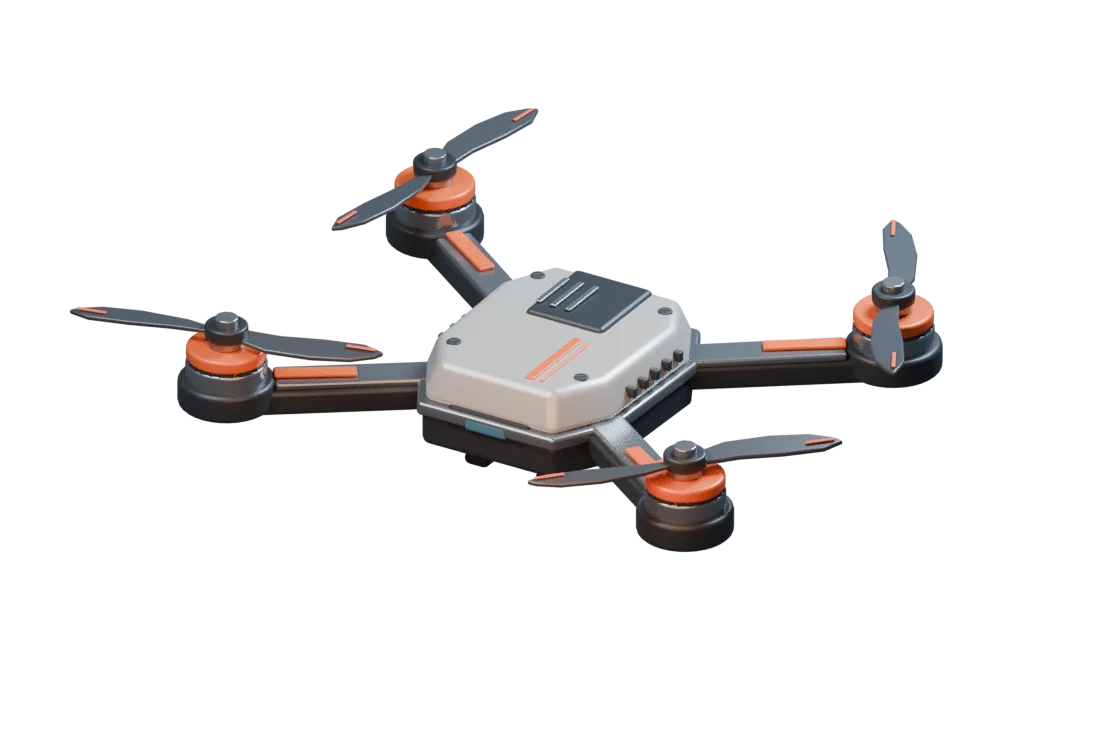
Flight envelope400 g sample configuration
The airframe
Four motors produce lift. A flight controller adjusts their speeds to hold position or turn.
Propellers accelerate air downward and produce upward thrust. Each diagonal pair spins in the same direction, opposite to the other pair, so reaction torques can cancel in hover.
The controller uses sensor feedback to adjust each motor. Differences in upward thrust create pitch and roll. Differences in reaction torque create yaw.
A centrally mounted battery helps keep the centre of gravity near the geometric centre. The report’s 7.4 V, 1.5 Ah example stores about 11.1 Wh.
A rigid, symmetrical frame keeps the motors evenly spaced. Lower frame mass reduces the thrust needed to hover.
Flight mechanics
Change the mass and thrust to see the quadcopter’s vertical acceleration in a simplified force model.
T − mg = maNewton’s second lawAt hover, upward thrust equals weight.
By Newton’s third law, air pushed downward exerts an upward reaction force.
τ = rF sin θMoving a payload away from the centre increases its turning effect.
P = VIAt 7.4 V and 4 A, the electrical input is 29.6 W.
The investigation
Compare the report’s sample observations with the predictions from force, power and torque.
Experiment 01
The sample series climbs from 1.55 N at 9.99 W to 4.25 N at 28.49 W. The extra thrust per watt decreases at the upper end of the series.
The test plan pairs a lightweight four-motor frame with a flight controller, battery and propeller guards. A balance, multimeter, thrust stand, stopwatch and known masses provide the test readings.
Battery voltage can sag during testing. Vibration, uneven propellers, motor heating, load placement and stopwatch timing can also affect the readings. Repeat runs under similar conditions and log voltage under load.
School applications
The project proposes ways to use a small quadcopter for demonstrations and supervised school activities.
Make equilibrium, torque, energy and motor control visible through supervised bench tests.
Map outdoor areas, study sports-field layouts, or inspect rooftops and solar panels with an approved operator.
Document tree cover, gardens, drainage and waterlogging over time from approved areas.
Explore sensor feedback, flight-data logging and obstacle detection in controlled STEM activities.
Use propeller guards, keep people clear of the flight path and run tests in an approved area under trained supervision. Follow school and aviation rules, and get permission before capturing images.
Log voltage, current and acceleration across repeated trials. Compare propeller setups by thrust per watt to see which can sustain hover more efficiently.
Project archive
The original report includes the construction method, calculations, bibliography and viva questions. The A4 sheet collects the three printed graphs.
Upward thrust equals weight, so T = mg and vertical acceleration is zero.
Counter-rotation helps cancel the reaction torques that would otherwise turn the body about its vertical axis.
A heavier drone needs more thrust to hover. The motors generally draw more power, using up the battery sooner.
The listed maximum thrust is about 8% above the unloaded weight, leaving little extra thrust for extra mass or manoeuvres.